A man hijacked an airplane, collected a fortune in ransom money, parachuted into the darkness, and was never seen again.
Overview
On November 24, 1971, a man calling himself “Dan Cooper” boarded a Northwest Orient Airlines flight with a briefcase he claimed contained a bomb. After demanding $200,000 and four parachutes, he released the passengers, ordered the plane back into the air, and jumped out somewhere over the Pacific Northwest. Despite one of the largest investigations in FBI history, his true identity has never been discovered. So did D. B. Cooper survive the dangerous jump and disappear with the money, or did he crash somewhere in the wilderness, never to be found?
The Background
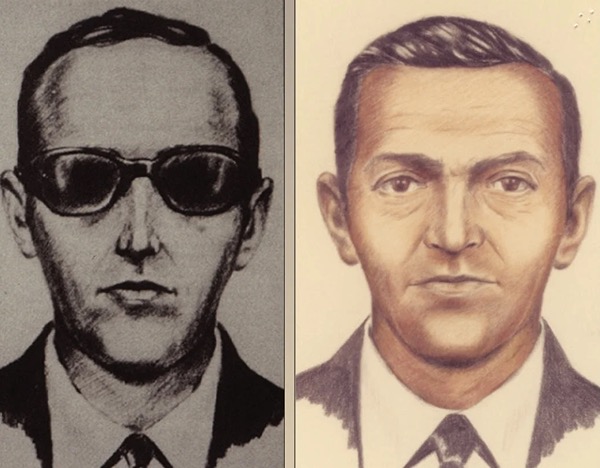
The mystery began the day before Thanksgiving in 1971 at Portland International Airport in Oregon. A man using the name Dan Cooper bought a one-way ticket with cash for Northwest Orient Flight 305, which was flying to Seattle, Washington. He looked like an ordinary businessman, wearing a dark suit, white shirt, black tie, and sunglasses. Witnesses later described him as calm, polite, and confident.
Shortly after takeoff, Cooper handed a note to a flight attendant. At first she thought it was a phone number and tucked it away, but Cooper quietly told her she should read it because he had a bomb. When she sat beside him, he opened his briefcase just enough to reveal wires and red cylinders that appeared to be explosives.
Cooper demanded $200,000 in cash, four parachutes, and a fuel truck waiting in Seattle. When the plane landed, authorities delivered everything he requested. The passengers were released, but Cooper kept the pilots and several crew members on board. He then ordered the plane to take off again and head toward Mexico City.
What We Know
Sometime during the flight between Seattle and Reno, Nevada, Cooper prepared for his escape. He tied the ransom money to himself using parachute cords, lowered the aircraft’s rear staircase while the plane was still flying, and jumped into the cold, rainy night.
When the plane landed safely in Reno, Cooper was gone.
Investigators recovered several important pieces of evidence. Cooper had left behind his black clip-on tie, which became one of the most valuable clues in the case. Years later, scientists examined the tie and discovered tiny metal particles on it. Some researchers believe these particles suggest Cooper may have worked in engineering, aerospace, or a manufacturing job where specialized metals were common.
The FBI had also carefully recorded the serial numbers of every $20 bill included in the ransom. This decision would become one of the most important parts of the investigation.
The Investigation
The FBI launched an investigation known as NORJAK, short for “Northwest Hijacking.” It became one of the largest and longest investigations in the agency’s history.
Investigators interviewed hundreds of witnesses and examined thousands of tips. Flight attendants provided detailed descriptions of Cooper’s appearance and behavior, allowing artists to create sketches that were shared across the country. Although investigators found fingerprints inside the aircraft, none could be matched to a suspect.
The airplane itself also provided important evidence. Investigators confirmed that the rear staircase had been lowered during flight, helping them estimate where Cooper likely jumped. They also studied the parachutes. Cooper had requested four parachutes, possibly to convince authorities he might take a hostage, making it less likely they would give him faulty equipment.
Interestingly, investigators later discovered that Cooper chose one parachute that was actually intended for training rather than steering. This suggested he had some knowledge of parachuting but may not have been an expert.
In 1980, the investigation took an unexpected turn. An eight-year-old boy digging along the Columbia River near Vancouver, Washington, found nearly $6,000 in badly decayed $20 bills. The serial numbers matched Cooper’s ransom money exactly. It remains the only ransom money ever recovered.
The Mystery
The discovery of the money only made the mystery more confusing. Investigators still do not know how the cash ended up buried along the riverbank. Some believe Cooper landed nearby and accidentally lost part of the ransom. Others think he died during the jump and the money was carried downstream by the river over time.
Many experts question whether anyone could have survived the jump at all. Cooper leaped into darkness during bad weather while wearing a business suit and dress shoes. He landed somewhere over heavily forested mountains with freezing temperatures and limited visibility. If he survived the fall, he still would have faced the challenge of finding his way out of the wilderness without being seen.
Over the years, the FBI investigated hundreds of suspects. One of the best-known was Richard Floyd McCoy Jr., who committed a similar skyjacking months later. However, he did not match witness descriptions and was eventually ruled out. Despite decades of investigation, no suspect has ever been proven to be D. B. Cooper.
The FBI officially closed its active investigation in 2016, but the mystery continues to capture people’s imagination. With no body, no confirmed identity, and only a small portion of the ransom money ever recovered, the case remains unsolved. More than fifty years later, one question still remains: did D. B. Cooper escape with the money and live out the rest of his life in secret, or did he disappear forever somewhere beneath the forests of the Pacific Northwest?
