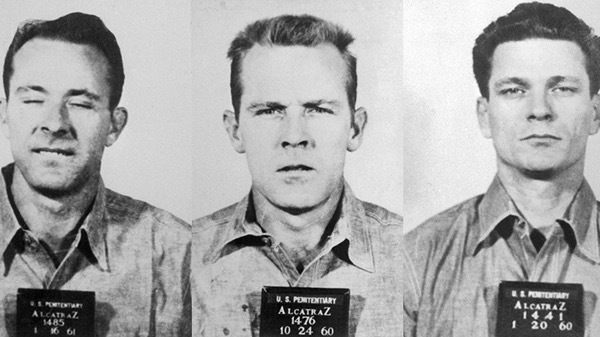
Three prisoners vanished from America’s most secure prison, and more than sixty years later, no one knows whether they escaped to freedom or disappeared forever.
Overview
In June 1962, Frank Morris and brothers John and Clarence Anglin carried out one of the boldest prison escapes in American history. Using homemade tools, fake heads, and a handmade raft, they slipped out of Alcatraz Federal Penitentiary without guards noticing until the next morning. Investigators found evidence showing exactly how they escaped the prison itself, but one question has never been answered: did the three men survive the dangerous waters of San Francisco Bay, or did they die trying to escape?
The Background
Alcatraz Federal Penitentiary opened in 1934 on a small island in San Francisco Bay. Nicknamed “The Rock,” it was built to hold some of the country’s most dangerous criminals. The prison’s location made it seem impossible to escape. Cold water, strong currents, and the long swim to shore discouraged even the most determined prisoners.
Frank Morris arrived at Alcatraz in 1960 after several convictions and previous escape attempts from other prisons. He was known for being highly intelligent and good at solving problems. Brothers John and Clarence Anglin were also serving time at Alcatraz, and the three men became friends. Because their cells were next to one another, they secretly began planning an escape.
Another inmate, Allen West, helped with the preparations. However, on the night of the escape, he could not get out of his cell in time and was left behind.
What We Know
The escape took months of careful planning. Behind each prison cell was a small air vent. Using homemade tools, including a drill powered by a vacuum cleaner motor, the prisoners slowly chipped away at the concrete around the vents. They worked only during noisy times of the day so guards would not hear them.
To hide their work, they covered the damaged openings with painted cardboard that blended in with the walls. Once the holes were large enough, the men climbed into an unguarded utility corridor behind the cells.
Investigators later discovered a hidden workshop above the cell block. There, the prisoners built equipment for their escape. They collected more than 50 rubber raincoats and stitched them together to make a large inflatable raft and life vests. They sealed the seams using heat from prison steam pipes. They also carved wooden paddles and even built a small homemade periscope to watch for guards while they worked.
Perhaps the most famous evidence was what they left behind. Each man placed a realistic dummy head in his bed, made from plaster, soap, paint, and real human hair collected from the prison barbershop. During nighttime bed checks, guards believed the prisoners were asleep, giving them several extra hours before anyone realized they were gone.
The Investigation
On the night of June 11, 1962, Morris and the Anglin brothers climbed through the holes behind their cells, crossed the utility corridor, reached the prison roof, climbed down a smokestack, crossed the island, and launched their homemade raft into San Francisco Bay.
The next morning, prison officials discovered the escape and began a massive search involving the FBI, Coast Guard, and local law enforcement.
Investigators recovered several important pieces of evidence. A homemade life vest washed onto shore. Pieces of a wooden paddle were found near Angel Island. A waterproof package containing family photographs and personal letters belonging to the Anglin brothers was discovered floating in the bay. Investigators also found pieces of rubber that matched the homemade raft.
These discoveries proved the men had made it off the island and into the water. However, none of the evidence showed whether they reached land alive.
The Mystery
Officials believed the prisoners most likely drowned. The water surrounding Alcatraz is extremely cold, and the currents can quickly pull swimmers out into the bay. No confirmed sightings of the escapees were ever made, and investigators never found evidence that the men stole a vehicle, changed clothes, or received help after leaving the island.
The FBI investigated the case for 17 years before officially closing it in 1979. Even so, the U.S. Marshals Service continues to keep the case open because the men were never found and no bodies were ever recovered.
Today, experts still disagree about what happened. Some believe the homemade raft could have carried the men safely across the bay under the right conditions. Others argue that surviving the cold water would have been nearly impossible.
Without proof of either survival or death, the 1962 Alcatraz escape remains one of America’s greatest unsolved mysteries. It is remembered not only for its clever planning and remarkable engineering, but also for the unanswered question that still fascinates people today: did three prisoners actually escape from the most secure prison in the United States, or did the bay claim them before they ever reached freedom?
