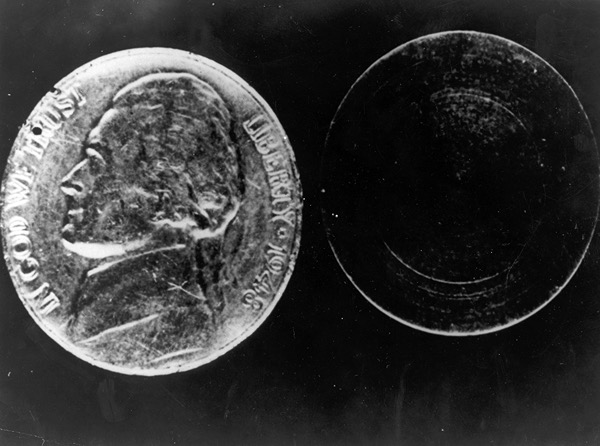
A small, ordinary-looking nickel found on a Brooklyn street revealed a hidden secret that would lead investigators into the dangerous world of Cold War espionage.
Overview
In 1953, a newspaper delivery boy discovered something strange about a nickel he had received as payment: the coin split open and contained a tiny piece of film hidden inside. During the Cold War, when the United States and Soviet Union were competing for information and power, investigators knew that hidden objects could be tools used by spies. The FBI began searching for answers, but the meaning of the message, the person who created the coin, and the identity of the suspected spy remained unknown for years. So was the hollow nickel really part of a Soviet spy operation, or was there another explanation for the mysterious object?
The Background
The Hollow Nickel case began during one of the most tense periods in modern history. In the early 1950s, the United States and the Soviet Union were locked in the Cold War, a global conflict based on political rivalry, military competition, and secret intelligence operations.
Spies from both countries worked to collect information about technology, military plans, and government activities. Because secret messages could not always be sent openly, intelligence agents developed creative ways to communicate. Some spies used hidden containers, coded messages, and disguised objects to avoid detection.
In June 1953, a newspaper delivery boy in Brooklyn received a nickel as part of his payment. When the coin accidentally dropped and broke apart, he discovered something unusual inside. Instead of a normal piece of metal, the nickel contained a tiny strip of film with extremely small markings.
Police quickly became interested in the strange discovery and contacted federal authorities. The FBI took control of the investigation because the object appeared similar to tools used by spies. However, investigators faced a difficult challenge: they had a mysterious object, but they did not know who made it, who used it, or what the hidden information meant.
What We Know
The strange nickel became the first major clue in a much larger investigation. Experts carefully examined the coin to understand how it had been altered. They looked at the way it was constructed, the marks left by tools, and how the hidden compartment had been created.
Inside the coin was a tiny piece of film that contained rows of numbers and symbols. Because the writing was too small to read normally, investigators had to use special techniques to enlarge and study the message. The technology involved in shrinking photographs, known as microphotography or microdots, was a common method used by spies to hide information.
The FBI also studied other possible clues connected to the hidden message. Investigators examined the type of printing used, the materials involved, and whether the object matched known spy equipment.
For several years, however, one major question remained unanswered: who was the person behind the hidden messages? Investigators referred to this unknown individual by the code name “Mark.”
As the investigation continued, agents collected more information about possible Soviet intelligence activities in the United States. Eventually, a new source would provide investigators with information that changed the direction of the case.
The Investigation
The biggest breakthrough came in 1957 when a Soviet intelligence officer named Reino Hayhanen decided to leave the Soviet spy network and cooperate with American officials. He provided investigators with information about his work as a spy and described another agent who used the code name “Mark.”
Hayhanen gave investigators details about the mysterious spy’s appearance, habits, and locations connected to the operation. The FBI compared this information with people they had been monitoring and began focusing on a quiet photographer named Emil Goldfus.
As investigators watched Goldfus, they discovered clues that suggested he might be connected to the spy network. When Hayhanen was shown a photograph of him, he identified Goldfus as the person known as “Mark.”
The FBI continued gathering evidence before making an arrest. Agents searched locations connected to the investigation and found unusual objects that appeared to be related to secret communication. These included hidden containers, photography equipment, and materials that could be used to create secret messages.
Among the items discovered were objects designed to look ordinary but hide important information. One example was a fake battery that appeared normal from the outside but contained a secret compartment inside. Investigators believed these types of devices showed how carefully spies planned their activities.
The Spy Mystery
The Hollow Nickel case became a puzzle built from many small clues. Investigators had to determine how the nickel worked, who used it, and whether it was connected to a larger spy network.
The evidence raised several important questions. How did the hidden message inside the coin connect to the people involved? Who was “Mark”? Were the strange devices found by investigators proof of a larger operation? And how could a simple nickel reveal information that had been hidden for years?
The case eventually led investigators to a suspected Soviet intelligence officer, but proving the full story required connecting many different pieces of evidence. The investigation involved science, surveillance, code-breaking, and careful detective work.
The Hollow Nickel mystery remains one of the most famous Cold War spy cases because it shows how a tiny object can become a major piece of history. A broken coin, a hidden message, and a trail of unusual clues forced investigators to uncover a secret world operating right in the middle of the United States. The question researchers still explore is: which clue finally revealed the truth behind the hollow nickel?
